Thursday, October 29, 2015

"R" is for Rya Knot

"R" is for Rya Knot

First off.... my spell check doesn't know the word: Rya.... Who put this dictionary on my computer? Me thinks he/she forgot some very important words,

To begin, cut your yarn to individual lengths. Maybe use a cardboard or mat board to cut the yarn to uniform lengths. Or a neat trick is to use already cut yarn lengths sold for rug hooking.


On a closed shed, place a length of yarn around two warp ends.


(The needle is just to hold the threads because I couldn't take the picture and hold the threads too) Hold the ends together in one hand.. (the part under the needle), and with the other hand separate the two warp ends and pull a loop of yarn through the center of the two warp ends.
 

Pull the ends of the yarn through the lifted loop.


Pull down knot to tighten. Weave at least two rows of plain weave before beginning another row of knots.Then you can go back and trim to length before you began another row of knots or even wait until you have finished weaving the project.

Wednesday, October 28, 2015

Towel Exchange Anyone?

When you have been snowed or iced out of your end of the year holiday party, you take matters into your own hands and tell Mother Nature to just step aside.....

 That is what my Cabool weavers did! We had our yearly get-together with a towel exchange. How many towels you bought you got to take home that many. All the towels were wonderful and we didn't fight to much over them. We had show and tell, food, towels, food, fun, stories, fun, and did I mention food?
This awesome towel was woven by Larry! And it got to go home to my house!! Yeah!!


Hey look, someone got my picture. I was trying to remember how I got my stripe sequence. 

Becky and her red and white towels. 

Gayle is showing her towels with Barbara, Bo, and Larry watching..

Jane is showing the towels she made (Gayle likes them).

Katie is showing how she used "Airplane Man's shirt" to get her strips. It is a long story.... maybe I will let her tell it someday. LOL

Sam had several great towels.

Shirley's towels went quick. Love the purple strip.

I know Vicki has towels in the exchange, but I couldn't help but show off these Rep Weave, painted warp, runners! WOW-Vicki..... you blew my socks off with these.  Painted Warp!!! What an awesome idea with Rep. 

Tuesday, October 27, 2015

"Q" is for Quills

"Q" is for Quills

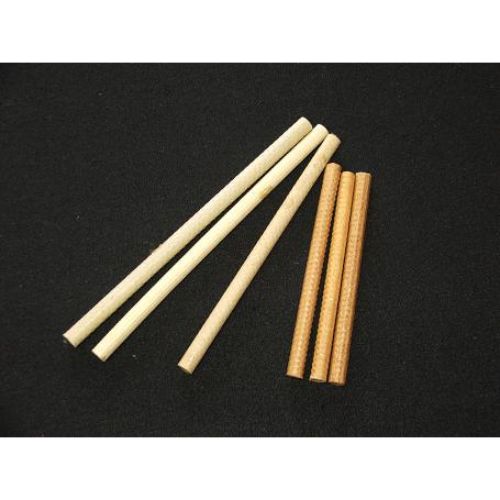
I have never used quills, but from reading I have found out that they do not have sides like bobbins and can be made of cardboard. I found several web sights telling how to wind them. I found a place that sold them 10/pack for $6.50. Maybe I need to try them?

Sunday, October 25, 2015

"P" is for Project Notes

"P" is for Project Notes

Not too many of us weavers just jump onto the loom bench and start weaving away. We have had to do a bit of prep work before hand. If you are weaving a project either you own or another, you will probably follow a "recipe." This recipe is considered project notes.

Information we will need before you begin may include:
1. Technique (weave structure)
2. Warp yarns and size
3. Weft yarns and size
4. Reed, and ends per dent
5. Selvage- doubled, single, needed or not
6. Warp sett
7. Weft picks per inch
8. Width in reed
9. Number of ends needed
10. Weaving length on loom that includes any finishing to the ends, sampling, shrinkage.

You many never weave this same project again with the same yarns, but by keeping project notes you are working through your project and hopefully will not find any surprises when you are finished.

So even if you follow a "recipe" from a book, magazine, the internet, or one you create, it really-really helps to keep project notes. Note in the margin if you changed anything from the printed recipe. It will help you be a better weaver.

Here is how I keep my project notes. Because these are my notes, some info may not be written down, such as selvage used, just because I know me! Or I may not even say to use tabby, but I will know, because it is something I dreamed up. So if you think my notes are skimpy... they may be, but they work for me.

I find working with a computer weaving program works for me. There are several out there, find the one that works for you. Keep notes that work for you!


Friday, October 23, 2015

"O" is for On-Opposites

"O" is for On-Opposites

We have heard this expression "on-opposites" and maybe not been real sure what it was. If you have ever woven plain weave you have woven on-opposites. You weave one equal half the threads against the other equal half of threads. You may have put your threads on shafts 1 and 2 only for a two shaft weave or plain weave. You may have put half your threads on shafts 1 & 2 in the case of summer and winter. In that case you would weave shafts 1+2 versus all the other shafts. Or you have put your tie-up in a two-two twill.


If you have your tabby treadles tied up as above, to weave on-opposites, you will weave 1 versus 2.


On a four shaft loom with a balanced twill tie-up (2/2) is divided into two pairs.
Shafts 1 & 2 versus 3 & 4
Shafts 2 & 3 versus 4 & 1

The treadling order pairs up the two blocks or sheds that are the exact opposite of one another.

 So you can think about weaving your plain weave web on opposites, or think about the different blocks you are weaving. If you want to weave on opposites ,or in pairs, you will need enough treadles where you have two different treadles for each block used.

Thursday, October 22, 2015

"N" is for Novelty Yarn

"N" is for Novelty Yarn

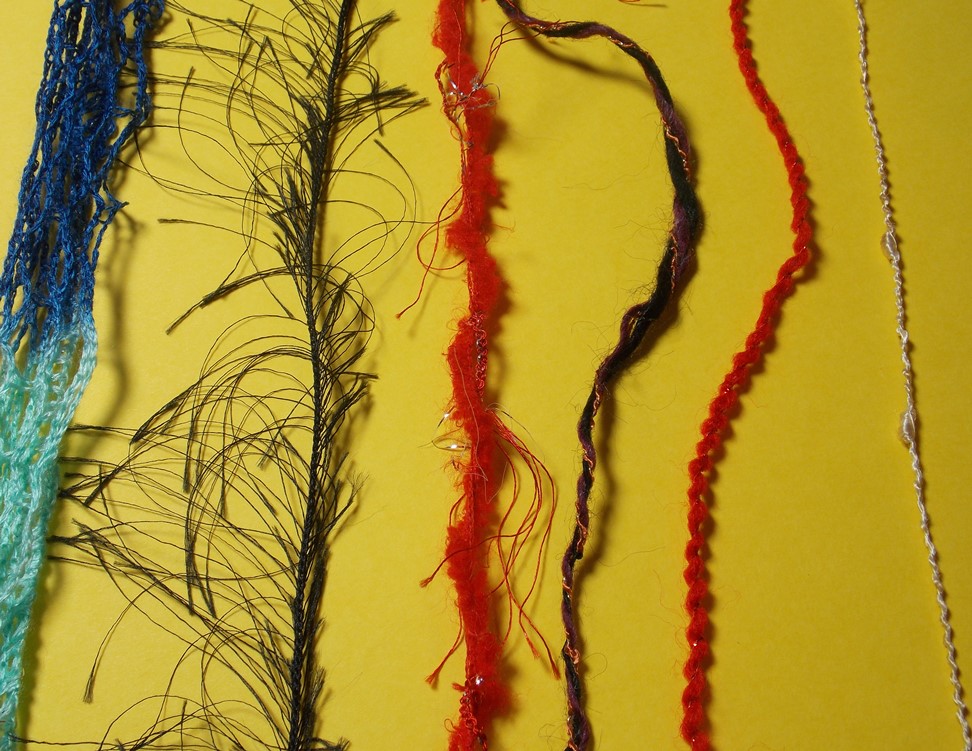
Just what is Novelty Yarn?
Novelty: a small manufactured article especially for personal or household adornment, usually without intrinsic value or merit.
Yarn: any spun thread (wool, flax, silk, cotton etc.) prepared for weaving, knitting, rope making etc.

But, we know novelty yarn can be fun, silly, expensive, hard to find, lovely!


And we know we can weave and create fun things with our novelty yarns!


I hope you have fun weaving with novelty yarn. Maybe you add a few ends in the warp, perhaps a few shots in the weft....
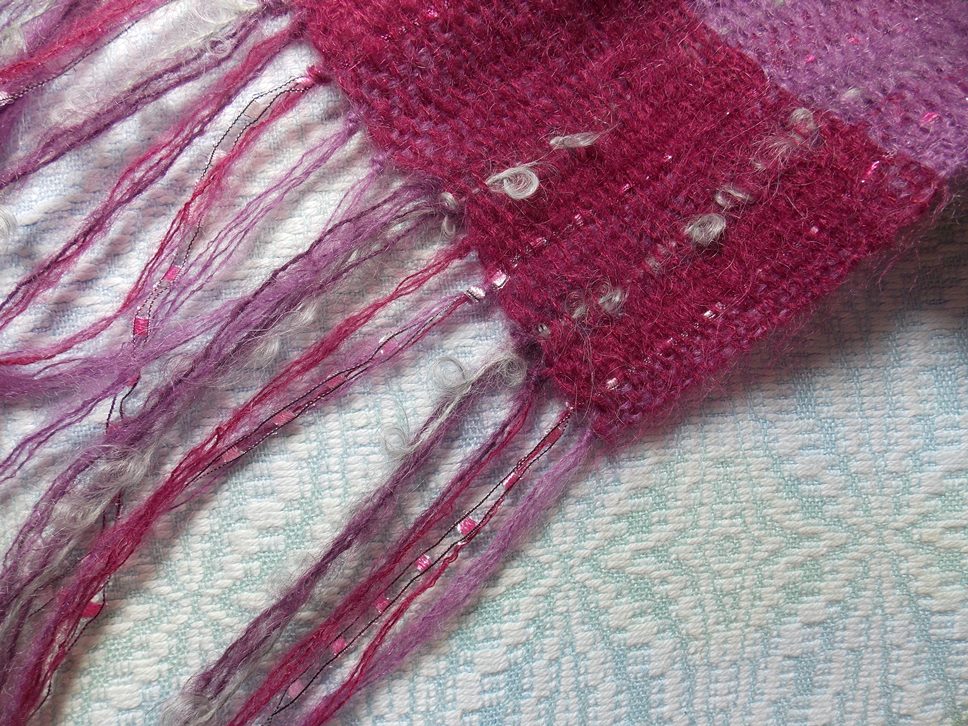
Here my friend, Bo, has used ladder yarn and other novelty yarns in this awesome scarf!!

Wednesday, October 21, 2015

"M" is for Motif

"M" is for Motif

If you are a lover of coverlets and overshot, you are likely aware of the different motifs that make up those patterns. I think most of the weavers I know fell in love with overshot from the very beginning of their weaving adventures. I know I did. The drafts usually were for a four shaft loom and was a great way to learn to 'square your motifs' , 'weave as drawn-in' , 'use two shuttles' , 'connect with the past'. The motifs were combined and rearranged to create wonderful textiles. And who couldn't love some of the names for the pattern: Missouri Trouble, Alabama Beauty, Orange Peel, Wandering Vine, Indiana Frame Rose, Rose in the Wilderness, Dutchman's Fancy, and Lee's Surrender.

Here are a few examples.

Wheel

Table

Rose

Leaf