Tuesday, October 20, 2015

"L" is for Lindsey-Woolsey

"L" is for Lindsey-Woolsey

A course, stout material, made with linen warp and wool weft on a twill threading. This fabric was used as skirting by the British peasantry while it was most commonly used during the Civil War era in America for outer clothing. The name is from the components of the cloth produced.


Back in 2007, I took a week long class at John C. Campbell Folkschool where we studies 18th Century Textiles. This was my first time working with linen. The teachers were Barbara Miller and Pam Howard. We learned how to put linen on the loom and treadled different twill patterns using a wool weft.

The hand of this cloth isn't very soft or pleasant, but it was its durability that was important.


My samples woven at the school showing a washed sample and an unwashed sample.


Monday, October 19, 2015

"K" is for Kumihimo

"K" is for Kumihimo

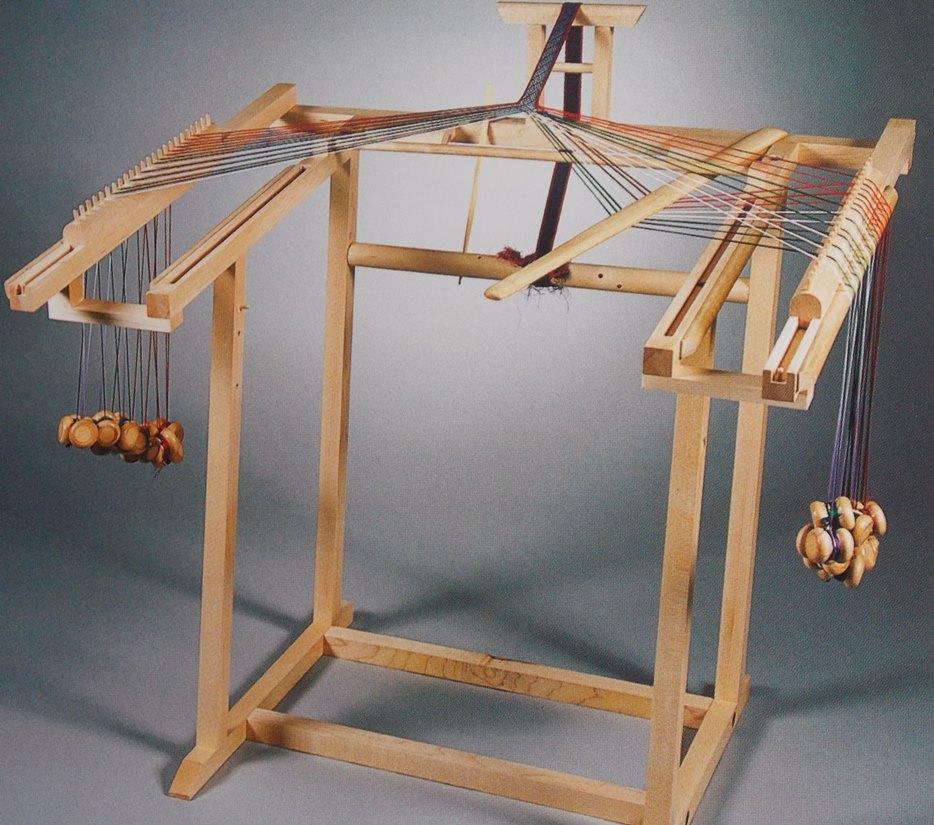
Kumihimo is a Japanese interlaced braid technique. While on a weaving loom the threads are woven with a horizontal and vertical structure, the braids made with the TAKADAI have a diagonal structure known as oblique interlacing. This Takadai is one piece of braiding equipment developed in Japan. The braid is usually flat and be several inches wide.

This is the Takadai loom.


If wanting to explore this braiding technique a couple of small hand held  'wheels' or 'plates' have been fashioned to create the round or flat braids.


Using these small looms, you can create round braids to make a 'frog' for that evening jacket. Or a flat braid for an evening scarf, or a narrow strip of accent on a yoke. Lots of application for round or flat braids. 

One of my guild members (Rossanna) has been exploring kumihimo. Her introduction of beads into this technique is very exciting. So grab your takadai or disk or plate and create something exciting too!


One resource book - Making Kumihimo Japanese Interlaced Braids by Rodrick Owen. copyright 2004. 

Sunday, October 18, 2015

"J" is Just For Fun

"J" is JUST FOR FUN

Sometimes, don't we all just weave for the fun of it? Sometimes we weave to learn a new technique, sometimes it is for a gift or sometimes it is just to feel the shuttle in our hands and see the magic unfold in front of our eyes.


With this cute little guy I was learning to weave ticking. I had woven off the blue and white warp and tied on with black and white. Then I wondered what would happen if I took the fabric to the dye pot. So that is why the fabric is yellow and black stripped. So now I had this piece of dyed fabric and it told me it wanted to be a dogie. This is what turned I got!


When I took him outside for his photo session, he wanted to hold a flower I had made from a small twill sample. I think he was enjoying the cool crisp morning air out on the back porch. So remember to smell the flowers and weave a little for fun today!

Saturday, October 17, 2015

"I" is for Inspiration

"I" is for Inspiration

Just where do we, as weavers, get our inspirations? From books, from calendars, from the view out our windows? Here are a few places I looked.

This small wall hanging was inspired by this Missouri Conservationist magazine. It's a little bit Bateman, clasp weave, plain weave, and embroidery work. And just look at the really cool piece of wood from Linda!


These towels were a project that used 'strips'. I was trying for the Santa colors.


I had this bird feeder in the back yarn. Love all the colors in this one photo. I can see these colors blended into a jacket.

This came from a calendar. Who wouldn't love a scarf with these colors?

Friday, October 16, 2015

"H" is for Halftone

"H" is for Halftone


There are three areas of traditional overshot: pattern, background and halftones. When the pattern weft does not float above or below the rest of the fabric, but is woven in just as the tabby shots are, we call these areas halftones. This over-under alternation of your pattern weft ties the pattern weft securely to the ground cloth.

Notice the halftones on both side of the solid block. The solid white blocks are the background, the solid red the pattern blocks, and the 'spotted'  blocks are the halftone block. 

This awesome example is by Jeff Reynolds (Best of Missouri Hands),. 

Thursday, October 15, 2015

"G" is for Gamp

"G"is for GAMP

While learning about you next weave structure you might consider doing a gamp with it. It could be a color gamp, or a structure gamp. The information learned is always welcomed, but the gamp itself is truly awesome! The different ways the colors interact, or the different affects you can achieve just by changing the treadling. Next time you put on a warp,put a little extra and try weaving with a color you would't normally use with your warp color or change the tie-up after your project and see what you get.

Who wouldn't want to hang any one of these in their weaving studio???

Marilynn wove a color gamp in fine wool.

Here, Marilynn has a gamp using an overshot threading. I would call this a treadling gamp.

I found this example in the Weaver's Issue 20 on page 55. 

Wednesday, October 14, 2015

"F" is for Fringe

"F" is for Fringe

To complete a runner, scarf, rug, or other item you may want to add fringe to it. There are several different kinds of fringe treatment you may want to make to add to your finished article.

A scarf you may want to hemstitch, leave the fringe as is, twist the fringe, add beads..... lots of ideas.


For a rug you may like the look of a double-knotted fringe.......or how about a braided fringe?


Although I have not tried it, you can have fringe woven on four sides. The only requirement is a loom wide enough to allow for the extra threads needed to weave the fringe in addition to the width of the finished article.